
Help more researchers and the public discover your collections with SEO built for archives. We help public record offices, university special collections and community archives make catalogs, digitized records, reading room visits and events easy to find in Google and AI search.
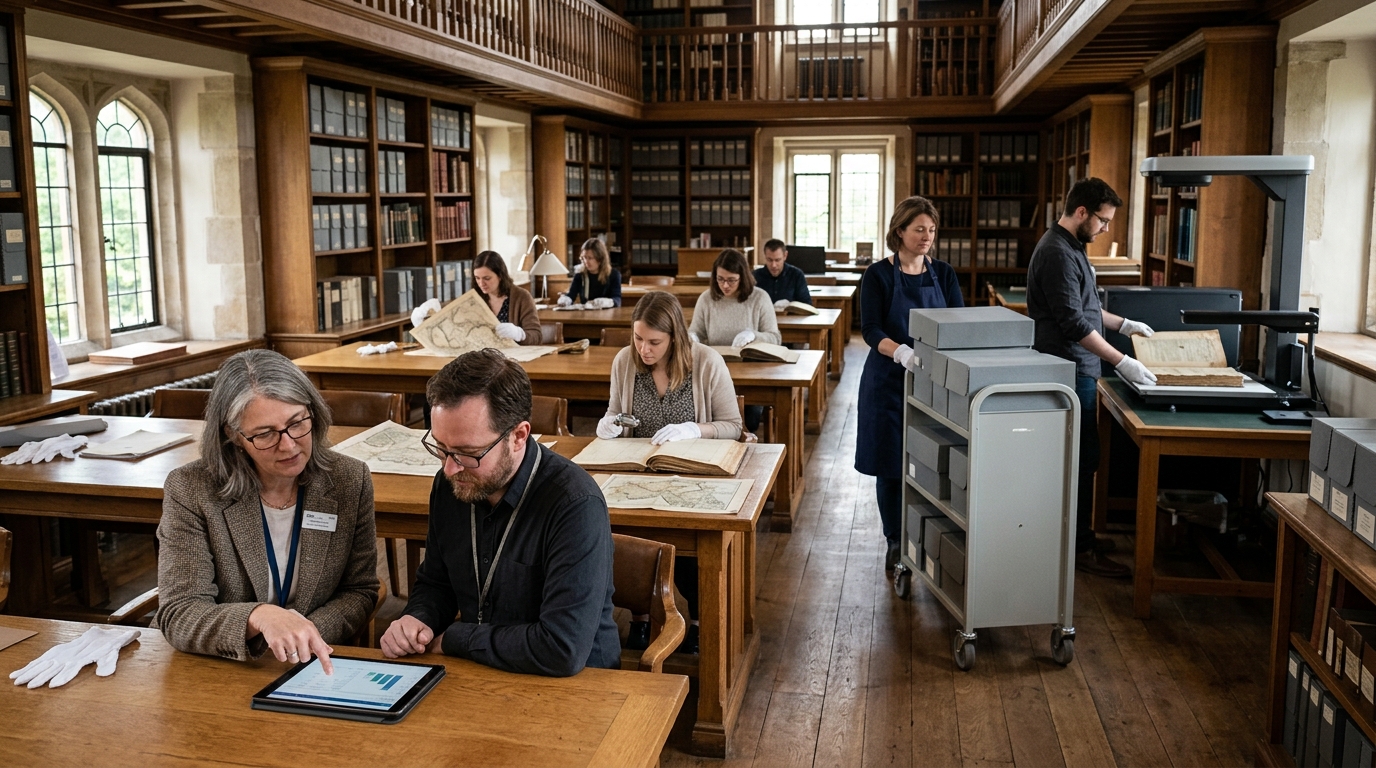
Most archive users do not search for your institution. They search for an ancestor, a street, a company or an event: “1921 census records for [town]”, “old photographs of [street]”, “parish records [county]”, “where are [company] records held”. Catalogs locked behind search boxes are invisible to Google. We build SEO around the name-first and place-first searches researchers use.
Archive SEO is the process of optimizing an archive or record office’s website, including collection guides, catalog records, digitized material, research guides, visitor information and event listings, so it ranks for the searches researchers, family historians, students and the public use. It combines technical SEO for catalogs, structured data, content and local SEO to increase discovery, visits and engagement.
Archives hold unique material, but it often sits in catalogs search engines cannot crawl. Your site has to expose collection descriptions and research guides without overwhelming visitors.
Members, families, partners and the public all search differently, and each needs a clear path through your site.
Make collection and item descriptions indexable so searches for names, places and events lead to your records.
Rank research guides and records alongside subscription genealogy sites, so family historians reach original sources.
Rank alongside larger organizations and directories for the program, service and information searches people make.
Build topical authority with useful educational, service and industry-focused content.
Help AI Overviews and assistants recommend your archive for detailed, conversational questions.
A complete search program covering technical foundations, content, local visibility and authority.
Improve crawlability, indexation, site architecture, Core Web Vitals, mobile performance, XML sitemaps, canonicalization and internal linking.
Identify high-value program, service, information and local keywords for your archive.
Optimize titles, meta descriptions, headings, URLs, content, images, internal links and search intent.
Structure program, service, admissions, event and information pages so people find answers fast.
Improve visibility for archives in local, regional and service-area searches through Google Business Profile, citations and location pages.
Create useful, search-led content around collections, record types, family and local history, digitized material, research access and preservation.
Build authority through relevant editorial links, digital PR, industry publications, partnerships and outreach.
Track rankings, organic traffic, enquiries, sign-ups, applications and other relevant SEO performance metrics.
A county record office and a university special collection serve different researchers. We plan around your collections, users and access rules.
Rank for local records, parish registers, maps and council archive searches.
Reach scholars and students searching for manuscripts, rare books and research papers.
Capture local history, old photograph and community heritage searches from residents.
Help researchers and media find company histories, product records and brand heritage.
Structure digitized collections and online exhibitions so individual items can rank.
Win searches for historical footage, oral histories and photographic collections.
Also see our pages for SEO for Army Barracks, SEO for Army Facilities, and SEO for Border Crossing Stations.
We map keywords to the right pages by search intent, rather than trying to rank a single page for every archive-related query.

Many archives serve a county, city or community, and their collections are rich in local names and places. Local SEO helps residents, local historians and visiting researchers find your reading room, opening hours and local collections.
Search is increasingly moving beyond traditional blue-link results. People now ask AI-powered search experiences for recommendations and expect direct, useful answers. Our Generative Engine Optimization (GEO) approach helps archives structure their content so search engines and AI systems can better understand, retrieve, summarize and potentially cite their information.
Clear headings, concise answers, logical content hierarchy and useful supporting information.
Strengthen relationships between your archive, its services, locations and relevant government agencies concepts.
Build comprehensive coverage around collections, record types, family and local history, digitized material, research access and preservation.
Create content around the natural-language questions people ask AI search platforms.
Connect related topics to establish stronger topical relationships.
Implement relevant structured data such as ArchiveOrganization, ArchiveComponent, Collection, Event and FAQPage markup where appropriate to help search engines interpret page information.
What makes us different from others.
Archives must balance open access with privacy, copyright and data protection. We keep sensitive and closed records out of search, respect reproduction rights and make access policies and accessibility information easy to find.
SEO services are not legal advice. Businesses should consult qualified legal professionals regarding laws and regulations applicable to their operations.
Analyze technical SEO, content, competitors, keywords, backlinks and current visibility.
Identify the searches that matter to your archive and map each one to the right page.
Develop the content, keyword, technical, internal-linking and authority-building roadmap.
Execute technical, on-page, content, information and local SEO improvements.
Optimize relevant content for direct answers and AI-powered search experiences.
Track performance and continuously refine the strategy based on data.
SEO experience across industries and business models.
Experience working across different websites and markets.
Focused on measurable SEO performance and client outcomes.
Recognised partner status across major ad platforms.
See how the same process has performed for clients across our other service lines.
Organic growth engagements broken down by challenge, strategy and outcome.
How we approach search for government agencies businesses, with the searches and challenges we see most.
Map-pack, Google Business Profile and location-page SEO for local businesses.
Let’s build a search presence that helps researchers and the public discover your collections and plan their visits.