

Industry AI / Dental Marketing
AI Marketing Tools for Dental Practices: Growth and Automation
Written By Nishi Singh • Last Update Oct 15, 2026
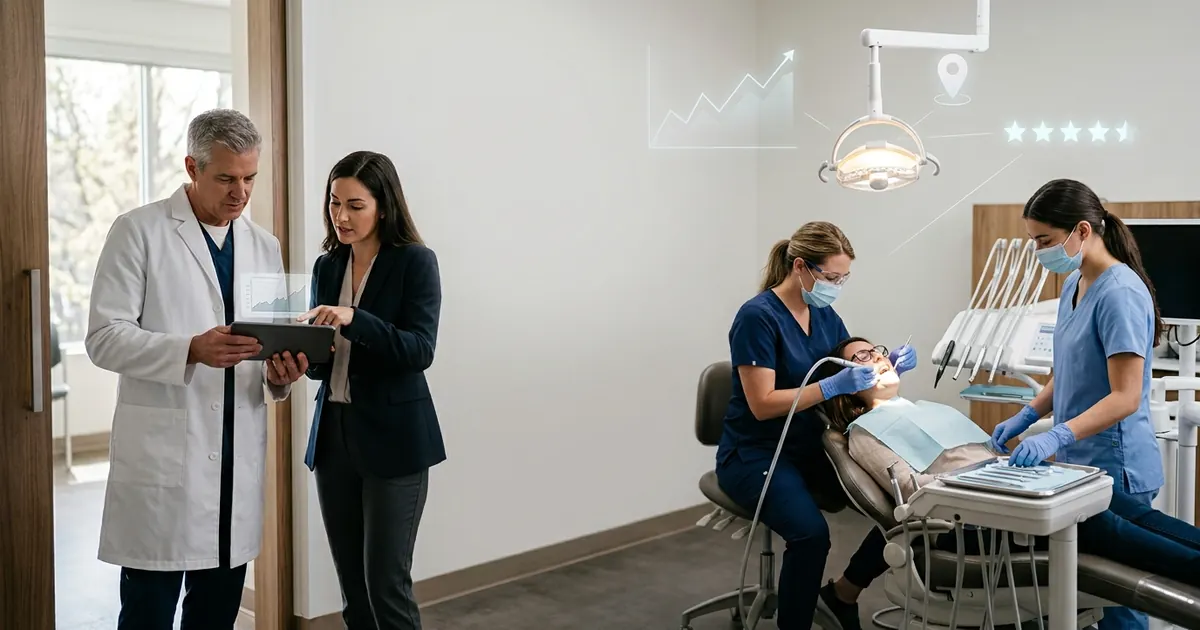
Dental practices sit on a marketing goldmine that most never fully use: a diary full of patients who are due back, a steady stream of treatment enquiries, and patients who would happily leave a review if someone asked. The difficulty is time, and the rules. Front-desk teams are stretched, and every message, advert and web page has to respect GDC guidance, the CAP Code and patient confidentiality. Used well, AI marketing tools for dental practices take on the repetitive work (answering out-of-hours enquiries, sending recalls, drafting treatment pages, following up consultations) while the clinical team keeps control of anything that touches care.
This guide is for practice owners, practice managers and treatment coordinators in mixed NHS and private practices, wholly private clinics and cosmetic dentistry groups. It covers patient acquisition, recall and reactivation, reviews, AI receptionists, and a compliance guardrails table you can share with your team.
Quick Answer: What are the best AI marketing tools for dental practices?
The most useful AI marketing tools for dental practices are the automation features inside your practice management software (online booking, reminders and recalls), a dental lead CRM with chat and follow-up for treatment enquiries, AI writing tools for treatment pages and Google posts, smart bidding in Google Ads, and review request automation. Each needs a clinician or manager checking claims, consent and patient data.
Key Takeaways
- Start with what your practice management system already automates, such as online booking, reminders and recalls, before buying new tools.
- Use AI to draft treatment pages, ads and posts, but have a clinician approve every claim against GDC guidance and the CAP Code.
- Treat patient data as special category health data: never paste records into public chatbots, and check every vendor's data processing terms.
- Automate review requests for every patient equally, and never confirm that a reviewer is a patient in your public replies.
- AI receptionists and chat can capture out-of-hours enquiries, but they must hand clinical and urgent questions to people.
Where do AI tools fit in a dental practice's marketing?
A dental practice is a small business with clinical obligations, so the usual playbook for online marketing for small business needs a compliance layer on top. It helps to map the patient journey first and then decide where AI genuinely saves time.
| Journey stage | What AI or automation can do | Example tools | Human checkpoint |
|---|---|---|---|
| Being found | Draft treatment pages, Google posts and ad variations | ChatGPT, Claude or Gemini; Google Ads smart bidding | Clinician signs off every claim, price and image |
| Enquiry | Answer website chat and calls out of hours, capture details, book consultations | Dental lead CRMs such as Dengro; dental AI receptionists such as Boxly | Clinical or urgent questions go straight to the team |
| Consultation follow-up | Treatment-specific nurture emails and texts after a consultation | Lead CRM sequences | Treatment coordinator reviews tone and timing |
| Ongoing care | Recalls, reminders and online booking | Practice management software such as Dentally | Recall intervals set clinically, not by marketing |
| Advocacy | Review requests and AI-drafted replies | Review features in your software, Google Business Profile | Replies never confirm patient status or treatment |
Dengro, for example, is a UK dental CRM that pulls treatment enquiries into one dashboard, sends practice-branded, treatment-specific auto-responses by email and SMS, and lists integrations with practice management systems including Dentally, EXACT, Aerona and SfD. Dentally, from Henry Schein One, offers online booking, a patient portal and automated reminders. Check what your own system already does before adding anything, and confirm current features and pricing with each vendor.
For the wider idea of agents that plan and act across several steps, our complete guide to autonomous AI marketing agents explains how they work and where they fall short.
How can AI help a practice win new patients through local search?
Most new private patients start with a search such as "dentist near me", "emergency dentist" or "dental implants cost" plus a town name. AI can speed up the work that wins those searches, provided someone with clinical knowledge checks the output.
Google Business Profile
Choose accurate categories, list every treatment as a service, add real photos of the practice and team, and post regularly about availability, new clinicians or patient information evenings. AI can draft a month of posts in minutes. Be careful with words: if your profile, website or ads use "specialist" or "orthodontist", the clinician must be on the relevant GDC specialist list. Our guide to AI agents for local business marketing covers reviews, citations and local pages in more depth.
Treatment pages that answer real questions
Each major treatment (implants, clear aligners, composite bonding, whitening, emergency appointments) deserves its own page covering what it involves, who it suits, the stages, risks, costs or "from" prices, finance options and the clinicians who provide it, with their GDC numbers. An AI assistant can turn a clinician's notes into a well-structured draft, but it should never invent outcomes, success rates or timescales. Ask it to flag every factual claim for review.
Visibility in AI answers
Patients increasingly ask ChatGPT, Gemini or Google's AI Overviews questions like "what does an implant consultation involve". Clear, specific treatment pages, consistent practice details across the web and genuine reviews give those tools accurate material to draw on. Our generative engine optimization checklist walks through the basics.
How should a practice use AI in Google Ads for implants and Invisalign?
High-value treatments such as implants and clear aligners (including branded systems like Invisalign) are where paid search usually earns its keep, and where mistakes cost most. AI helps in two places: smart bidding, which adjusts bids towards the conversions you define, and ad copy drafting, which produces headline and description variations to test.
- Separate campaigns by treatment, so budgets, keywords and landing pages match what each patient is searching for.
- Send each ad to a matching treatment page, not the home page, with a clear consultation booking route.
- Define conversions carefully: consultation bookings and calls of a meaningful length, rather than page views. Smart bidding is only as good as the conversion data it learns from.
- Check every AI-drafted headline for claims you cannot substantiate, such as "pain-free" or "perfect smile guaranteed".
- Respect health targeting rules. Google's health in personalised advertising policy treats invasive procedures, including surgical procedures and injections, as a sensitive category, where Customer Match and your own data segments cannot be used. Check how it applies to implant or facial aesthetics campaigns before building remarketing audiences, and do not upload patient lists to ad platforms without a clear lawful basis.
Landing page testing matters as much as the ads; our post on AI agents for conversion rate optimization explains how to test pages without guessing.
How do you automate recalls and patient reactivation?
Recalls are the steadiest source of revenue in most practices, and the easiest to automate badly. Keep the clinical decision with the clinician: NICE guideline CG19 recommends setting the interval between adult oral health reviews by risk, anywhere from 3 to 24 months. Marketing's job is to make sure patients actually book.
- Let the practice management system own the recall date, set by the clinician at each examination.
- Automate the reminder sequence: a first reminder when the recall falls due, a follow-up a couple of weeks later, then a note for reception to call.
- Keep reminders administrative. ICO guidance says messages sent purely for administrative or customer service purposes are not direct marketing, but adding promotional material makes them marketing. A reminder that a check-up is due is closer to a service message; one that also promotes whitening is marketing.
- Reactivate lapsed patients with consent. For patients who have not attended for a long time, a warm "we'd love to see you again" campaign needs marketing consent or a valid soft opt-in, with an opt-out in every message.
- Follow up undecided consultations. Patients who had an implant or aligner consultation but did not proceed can receive a short, treatment-specific sequence that answers common questions about cost, finance and recovery, without pressure.
If you are unsure whether a recall message counts as marketing, treat it as marketing or take advice. Our guide to AI agents for email marketing covers sequence design in more detail.
How do you generate more reviews without breaking the rules?
Reviews influence which practice a nervous patient chooses, so a steady flow is worth automating. Send the same request to every patient after their appointment, by text or email, with a direct link to your Google review form. Google's policies prohibit selectively asking happy patients, offering incentives such as discounts, and pressuring people to review on the premises. In the UK, the Digital Markets, Competition and Consumers Act 2024 has banned fake reviews and reviews that conceal an incentive since 6 April 2025.
Replies need particular care in dentistry. AI can draft a polite response, but a person must check it never confirms that the reviewer is a patient or mentions their treatment, in line with your confidentiality duties under the GDC's Standards for the Dental Team. For a complaint, a short reply inviting the person to contact the practice manager directly is safer than any detailed public answer.
Should a dental practice use an AI receptionist or chatbot?
Missed calls and unanswered website enquiries are lost patients, especially for high-value treatments that people research in the evening. That is the main case for AI receptionists and chat. Boxly, for example, launched a dental AI receptionist in the UK in October 2025 that gives treatment-specific responses, books into the practice diary and follows up on channels such as WhatsApp, and Dengro offers a dental-specific chatbot connected to its lead dashboard.
Before switching one on, set guardrails:
- Scope: the assistant answers practical questions (opening hours, prices from your price list, finance, what a consultation involves) and books appointments. It does not give clinical advice.
- Escalation: anything urgent, such as swelling, trauma or severe pain, is routed to the team in hours and to NHS 111 or your out-of-hours arrangement otherwise.
- Integration: check whether the tool is an approved integration for your practice management system, and how it reads and writes appointments.
- Data: confirm where call recordings and chat transcripts are stored, how long they are kept, and that a data processing agreement is in place. Carry out a data protection impact assessment before going live.
- Transparency: tell callers and chat users they are speaking to an automated assistant, and offer a route to a person.
What compliance guardrails do AI marketing tools for dental practices need?
The rules below apply whether a person or a tool writes the content. Share this table with whoever approves your marketing.
| Area | Rule or source | Guardrail for AI-assisted marketing |
|---|---|---|
| Website and advert content | GDC guidance on advertising | Show GDC numbers, qualifications and where they were obtained, practice address, complaints procedure and NHS, mixed or private status; keep it accurate and dated |
| Specialist titles | GDC specialist lists | Block "specialist" or titles such as "orthodontist" unless the clinician is listed; use "special interest in" or "experienced in" instead |
| Social media treatment ads | GDC guidance on advertising | State that treatment may not be appropriate for every patient and depends on a satisfactory assessment |
| Claims and before-and-after images | CAP Code and CAP advice on dental advertising | Hold evidence for objective claims; use genuine, representative images with signed and dated proof; no exaggerated outcomes |
| Use of "Dr" | CAP advice on dental advertising | Do not imply a general medical qualification the dentist does not hold |
| Facial aesthetics | CAP Code on prescription-only medicines | Do not advertise Botox or other prescription-only medicines to the public; promote consultations instead |
| Patient data | UK GDPR (health data is special category data) | No patient details in public AI tools; data processing agreements with vendors; minimum data in every system |
| Marketing texts and emails | PECR | Consent or valid soft opt-in, opt-out in every message, records of both |
| Reviews | Google policy; DMCC Act 2024 | Ask every patient, no incentives, no confirming patient status in replies |
The primary sources are the GDC's guidance on advertising, CAP's advice on dental advertising and the ICO's explanation of special category data. The safest use of AI in marketing for a practice is to build these checks into your approval step, so nothing goes live on a tool's say-so.
How NSP Global Services Can Help
NSP Global Services helps practices choose, connect and supervise the right AI marketing tools, with human strategy and compliance checks built in. Our SEO for dentists service covers local search and treatment pages, our PPC for dentists team manages Google Ads for high-value treatments, and our digital marketing for cosmetic dentists brings the channels together.
If you want a review of your current set-up, from recall messages to treatment pages, get in touch with our team.
Conclusion
The right AI marketing tools for dental practices remove the repetitive work that keeps front-desk teams busy: chasing recalls, answering the same enquiries, writing first drafts and asking for reviews. They do not replace clinical judgement or professional responsibility. Start with your practice management system, add a lead CRM or AI receptionist where enquiries are being missed, and route every claim, image and patient message through a human check. That combination brings in more of the right patients while keeping the practice on the right side of the GDC, the ASA and data protection law.
Frequently Asked Questions
Can AI write content for a dental practice website?
AI can produce useful first drafts of treatment pages, blog posts and Google posts from a clinician's notes, which saves a lot of time. Every draft still needs a clinician to check it, because AI can invent success rates, timescales or claims you cannot substantiate. Pages must also meet GDC advertising guidance, including GDC numbers, qualifications and clear, accurate information.
Is it safe to use ChatGPT with patient information?
Do not paste identifiable patient information into public AI chatbots. Health data is special category data under UK GDPR, so it needs a lawful basis, an Article 9 condition and strong safeguards. Use business tools with proper data processing terms, share the minimum data needed, and carry out a data protection impact assessment before introducing any AI system that handles patient details.
Do dental recall reminders need marketing consent?
ICO guidance says messages sent purely for administrative or customer service purposes are not direct marketing, so a reminder that a check-up is due is closer to a service message. Once a message promotes treatments such as whitening or offers, it becomes marketing and needs consent or a valid soft opt-in. If you are unsure, treat it as marketing or take advice.
Can a dental practice advertise Botox?
No. Botox is a prescription-only medicine, and the CAP Code does not allow prescription-only medicines to be advertised to the public. Practices offering facial aesthetics can promote consultations with a qualified professional, but they should avoid naming or implying specific prescription-only products in ads, social posts or AI-generated copy.
Can a general dentist describe themselves as an implant or orthodontic specialist?
Only dentists on the relevant GDC specialist list can use the title specialist or call themselves a specialist in a field. Other dentists can say they have a special interest in a treatment, are experienced in it, or that their practice is limited to it. Check that AI-written ads, profiles and pages follow the same rule.
How should an AI receptionist handle dental emergencies?
It should not try to triage clinically. Set it up to recognise urgent situations such as swelling, trauma or severe pain and pass them straight to the team during opening hours, or direct patients to NHS 111 or your out-of-hours arrangement otherwise. Test these scenarios before launch and review transcripts regularly to make sure escalation works.
What should a dental practice measure to judge its marketing?
Track new patient enquiries by source, consultation bookings, treatment acceptance, recall booking rates, review volume and cost per consultation booked. Page views and clicks are useful signals but not results. Keep treatment details and patient identities out of advertising platforms, and report on enquiries and bookings instead.
How much do AI marketing tools for dental practices cost?
Costs vary widely. Many automations, such as online booking, reminders and recalls, are already part of practice management software, while dental lead CRMs and AI receptionists are usually separate monthly subscriptions. Check each vendor's current pricing and compare it with the value of the enquiries and recalls you are currently missing.

Nishi Singh
(Content Writer & SEO Manager)
NSP Global Services is a leading digital marketing agency specialising in SEO, content strategy, and paid advertisements — helping businesses across SaaS, B2B, and e-commerce achieve measurable growth online.
Posted on: Oct 15, 2026