

Industry AI / Salon Marketing
Salon Marketing Automation: AI Tools to Keep Content Consistent
Written By Nishi Singh • Last Update Oct 15, 2026
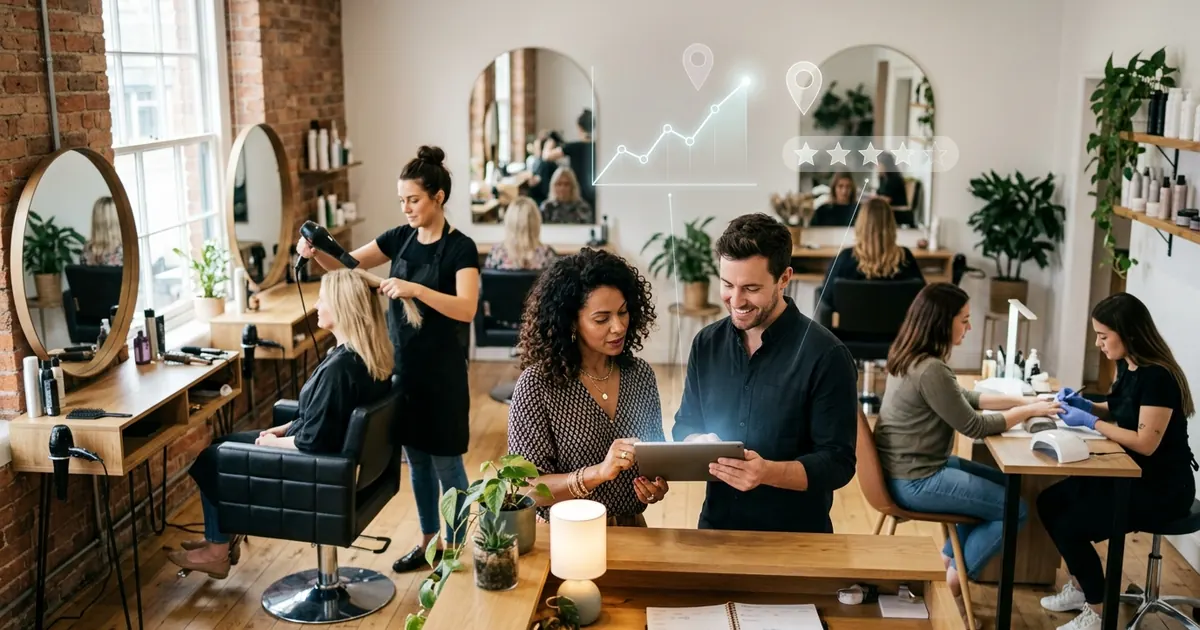
Most salon owners know what good marketing looks like: fresh work on Instagram every few days, a Google profile that looks cared for, clients nudged to rebook before their colour grows out, and a few new reviews every week. The hard part is keeping it going when you are also behind the chair, ordering stock and covering the rota. Salon marketing automation takes the repetitive jobs (reminders, rebooking prompts, review requests, scheduled posts) off your plate, so your time goes on the parts only you can do, such as taking great photos and looking after your regulars.
This guide is for owners and managers of hair salons, barbers, nail bars and beauty salons who want steady content without hiring a full-time marketer. You will get a content calendar that mostly runs itself, a tool stack table, the consent and review rules to respect, and a weekly one-hour routine.
Quick Answer: What is salon marketing automation, and which AI tools keep content consistent?
Salon marketing automation uses your booking software and a few AI tools to send reminders, rebooking prompts, review requests and seasonal offers automatically, and to schedule social and Google Business Profile posts. Most salons need three pieces: a booking platform with built-in marketing (such as Fresha, Phorest, Timely or Booksy), an AI writing and design tool, and a scheduler. A weekly one-hour review keeps it on brand.
Key Takeaways
- Start with the automations inside your booking software, because they run on real appointment data rather than guesswork.
- Plan a repeating monthly calendar first, then let AI tools draft posts to fit it.
- Get written consent before posting any client photo, and never use filters or edits that exaggerate a result.
- Send the same review request to every client with no reward attached, because Google prohibits selective asking and incentives.
- Keep reminders free of promotions, and only send marketing texts or emails to clients with consent or a valid soft opt-in.
- One hour of human checking each week stops automated content drifting off brand or going out with the wrong details.
What can salon marketing automation actually take off your plate?
Automation works best on tasks that repeat on a predictable trigger: an appointment is booked, a visit ends, a client has not been back for ten weeks, a bank holiday is coming. It works badly on anything that needs taste or judgement. Sort your marketing jobs into three groups before you buy anything.
| Marketing task | How to handle it | Why |
|---|---|---|
| Booking confirmations and reminders | Automate fully in your booking platform | Triggered by real bookings, no creative judgement needed |
| Rebooking prompts | Automate, with intervals your stylists set for each service | Your team knows how long a cut or an infill lasts; the software just remembers |
| Review requests | Automate, sent to every client in the same way | Consistency keeps you inside Google's review rules |
| Seasonal offers | AI drafts the copy, you approve and schedule | Offers affect your margin and the terms must be accurate |
| Instagram, Facebook and Google posts | AI drafts captions from your photos and notes, a scheduler publishes | Brand voice and facts need a human eye first |
| Replies to reviews | AI suggests a reply, you edit and post it | A generic answer to a complaint can make it worse |
| DMs, complaints, allergy and patch-test questions | Human only | Safety, health and relationships need a person |
This split is the heart of using AI in marketing sensibly at salon scale: the software does the remembering and the first draft, and the people who know the clients make the decisions. For the wider picture of how AI agents chain tasks together, see our guide to autonomous AI marketing agents.
Which AI marketing tools does a salon really need?
Most salons can run a consistent programme with three layers: the booking platform, an AI assistant for words and visuals, and a scheduler. Plenty of advice on online marketing for small business skips the first layer, but for a salon it is the most valuable, because it holds the appointment history every useful automation depends on.
| Layer | Example tools | What it handles | Check before you commit |
|---|---|---|---|
| Booking platform with marketing built in | Fresha, Phorest, Timely, Booksy | Reminders, rebooking prompts, campaigns to client groups, review requests | Which features sit on which plan, text message costs, how consent is recorded |
| AI writing assistant | ChatGPT, Claude, Gemini | Caption drafts, offer copy, review reply drafts, monthly ideas | Prices, dates and product names must be checked by a person |
| Design | Canva | Branded templates for offers, price lists and before-and-after layouts | Lock your fonts, colours and logo into a template |
| Scheduler | Meta Business Suite (Facebook and Instagram), Buffer (which also supports Google Business Profile), Google Business Profile's own scheduling | Publishing posts at set times | Whether every format you use can be scheduled |
| Reviews | Requests from your booking platform, replies in Google Business Profile | Collecting and answering reviews | No rewards, no asking only the happy clients |
Fresha
Fresha's automated messages include up to three appointment reminders, rebooking reminders, and deals for clients who have opted in to marketing. Its blast campaigns send one-off emails to client groups built from booking history, loyalty activity and engagement, and it connects to Reserve with Google so clients can book from your Google listing. Automated texts draw on a message balance, so watch usage.
Phorest
Phorest's marketing suite covers SMS and email campaigns with client segmentation, and its automations include confirmations, reminders, rebooking prompts, no-show follow-ups and review requests. It also describes a Front Desk AI that handles client messages and bookings around the clock.
Timely
Timely offers automated reminders and SMS marketing, and its help centre explains how to automate SMS campaigns that ask clients for Google reviews. Some features depend on your plan.
Booksy
Booksy's business plan includes automated text and email campaigns, and its Boost feature promotes you on the Booksy marketplace, which Booksy describes as having no monthly fee and a one-off charge when it brings you a new client.
Pricing for all four varies by country, team size and plan, and features move between tiers, so check each vendor's pricing page and ask for a demo using your own service menu. Pick one platform and use its automations properly before adding anything else.
How do you build a salon content calendar that runs on autopilot?
Consistency comes from a rhythm, not inspiration. Decide a weekly pattern once, map the salon year once, then let AI tools fill the slots. A simple pattern for a small salon:
- Transformation post: one before-and-after a week, only from clients who have given consent.
- Tip or aftercare post: making a blow-dry last, caring for gel nails, protecting colour in summer.
- Team post: a stylist's specialism, a new product, training someone has finished.
- Availability or offer post: quiet midweek slots, a new service, gift vouchers.
- Google Business Profile post: one update or offer a week, reusing the best photo.
Map the salon year once
Seasonal moments repeat, so plan them in January. Common anchors include the quieter weeks after New Year (good for midweek offers), Valentine's Day, Mother's Day (Mothering Sunday usually falls in March in the UK, while US Mother's Day is in May), wedding and prom season, holiday preparation for brows, lashes and pedicures, autumn colour changes in September, and party season and gift vouchers from November.
Let AI draft, with a proper brief
Give your AI assistant your service menu, prices, a few lines on your brand voice and the month's theme. A clear brief beats "write me an Instagram post". For example:
You write Instagram captions for a friendly, unfussy hair salon in a market town. Draft four captions for March: one transformation post (balayage, client has consented), one aftercare tip for coloured hair, one team introduction and one post about Mother's Day gift vouchers. Use UK spelling, keep each under 80 words, use one emoji at most and do not mention prices unless I give them.
If several people post for the salon, a short voice guide stops the feed sounding like five different businesses; our post on AI agents for brand voice consistency shows how to write one. For batching, approving and publishing, see our social media automation workflow.
How should a salon handle before-and-after photos and consent?
Before-and-after photos are a salon's best content, and the area where a careless shortcut causes real trouble. Photos of identifiable clients are personal data under UK GDPR, so treat them with the same care as a phone number.
- Ask for consent specifically for marketing, separate from any treatment record, and say where the photo may appear (Instagram, your website, Google).
- Record it in the client's booking record, so nobody posts a photo from a client who said no.
- Make withdrawal easy, and remove the photo from your channels and content folder if someone changes their mind.
- Take extra care with under-18s: ask a parent or guardian, or simply avoid posting photos of children.
- Shoot consistently and do not filter: same light, same angle, no edits that change the result.
That last point is an advertising rule too. In 2021 the ASA ruled that social media ads for tanning products were misleading because beauty filters exaggerated the effect, and CAP's advice on before-and-after imagery is that marketers should hold proof that images are genuine and representative. If your salon also offers aesthetic treatments, prescription-only medicines such as Botox cannot be advertised to the public under the CAP Code.
How do you automate rebooking reminders and seasonal offers without annoying clients?
The key distinction is between service messages and marketing. The ICO's guidance says messages sent purely for administrative or customer service purposes are not direct marketing, but adding promotional material turns them into marketing. An appointment reminder is a service message; the same reminder with "10% off your next colour" tacked on is marketing.
For marketing texts and emails in the UK, you need consent or the "soft opt-in", which covers existing clients who bought a similar service, were given a simple way to opt out when you collected their details, and are offered an opt-out in every message. The ICO's electronic mail marketing guidance sets out the conditions and notes it is under review following the Data (Use and Access) Act. In the US, marketing texts fall under different rules, so check consent requirements with your platform.
Rebooking prompts that feel helpful
Ask each stylist or therapist to set a rebooking interval for their main services, such as a root touch-up, a gel infill or a beard trim. The automation then sends a short prompt with a direct booking link when a client passes that interval without a future appointment. Sign it from the stylist where your platform allows.
Seasonal offers with clear terms
Build each campaign once: the audience (for example, clients with marketing consent who have not visited in three months), the message, the dates and the terms. State significant conditions clearly, such as which services, the end date and any minimum spend, as the CAP Code expects for promotions. Set your own frequency cap, for example two marketing messages a month. Our guide to AI agents for email marketing goes deeper on segments and sequences.
How do you automate review requests the right way?
A steady flow of reviews matters more than a one-off push, and the safe way to automate it is simple: send the same request, at the same point, to every client.
- Timing: a few hours after the appointment, with a direct link to your Google review form.
- No gating: Google's policy on fake engagement says businesses must not selectively solicit positive reviews. Some review tools collect private feedback first and invite only happy clients to post publicly, so make sure every client gets the public link.
- No rewards or pressure: Google does not allow discounts, freebies or payment for reviews, or pressing clients to review while still in the salon.
- UK law: since 6 April 2025 the Digital Markets, Competition and Consumers Act 2024 has banned fake reviews and reviews that hide an incentive.
For replies, let AI draft and a person approve. Keep it short and never confirm treatment details publicly; "thanks for coming in, Priya" is fine, naming the treatment she had is not. Negative reviews deserve a calm, personal reply from the owner and an offer to talk offline.
How do Google Business Profile posts fit into salon marketing automation?
Google Business Profile is often the first thing a new client sees when they search for a salon nearby. Google's help page on posts describes three types (updates, offers and events), lets you schedule a post or set it to repeat, and archives posts older than six months unless a date range is set.
Use the offer type for seasonal deals with clear dates, the update type for your weekly transformation photo, and keep adding fresh photos of your work and premises. If your booking platform supports Reserve with Google, check its conditions so clients can book straight from your listing. For reviews, local pages, citations and AI answers for "near me" searches, read our guide to AI agents for local business marketing.
What does a weekly one-hour routine look like?
Once the automations are live and the year is mapped, this routine keeps everything accurate. Do it at the same time each week, such as Monday before the first client.
- Minutes 0 to 10, check the automations: reminders sent, rebooking prompts, review requests, failed messages and opt-outs. Fix anything that has stopped.
- Minutes 10 to 25, choose the photos: pick the week's best before-and-afters, confirm consent for each, and crop or brighten without filters.
- Minutes 25 to 40, draft with AI: ask for the week's captions and one Google post, then edit for voice, prices and dates.
- Minutes 40 to 50, schedule: load posts into your scheduler and Google Business Profile, and click every booking link once.
- Minutes 50 to 60, reviews: approve or rewrite reply drafts, and flag any complaint for a phone call.
Add 30 minutes a month to plan the next month's themes and offers.
What are the risks of automating salon marketing?
- Invented details: AI assistants can make up services, prices or opening hours, so check every draft.
- Over-messaging: several automations firing at once can send one client three texts in a week. Review the schedule from a client's point of view.
- Platform rules: automated posting, DMs and comment replies must follow each platform's terms; mass-messaging or scraping tools can put your account at risk.
- Data spread: every tool holding client data is another place it can leak. Check storage, access and whether the vendor offers a data processing agreement.
How NSP Global Services Can Help
NSP Global Services helps salons choose, connect and supervise the right tools, set up rebooking and review automations that respect consent rules, and build the search side so new clients find you. Our SEO for hair salons and SEO for beauty salons services focus on local visibility, and our Instagram advertising team can put paid reach behind your best real work.
If you would like a second pair of eyes on your set-up, contact our team for a practical review of what to automate first.
Conclusion
Consistent salon marketing is not about posting more; it is about letting software handle the predictable jobs so your best work and best clients get your attention. Start with the automations inside your booking platform, map your year once, use AI to draft rather than decide, and protect clients' trust with clear consent and honest review requests. One focused hour a week keeps it accurate, on brand and working.
Frequently Asked Questions
What is the best booking software for salon marketing automation?
There is no single best option. Fresha, Phorest, Timely and Booksy all offer automated reminders and some form of marketing campaigns, but features, plan tiers and text message costs differ by country and team size. Compare how each records marketing consent, handles review requests and connects to Google, then ask for a demo using your own service menu before you switch.
Can I use AI to write my salon's Instagram captions?
Yes, and it saves a lot of time if you give the AI a proper brief: your services, prices, brand voice and the month's theme. Treat every caption as a draft. AI assistants can invent prices, services or opening hours, so a person should check the facts and the tone before anything is scheduled or published.
Do I need a client's consent to post their before-and-after photos?
Yes. Photos of identifiable clients are personal data under UK GDPR, so ask for consent specifically for marketing use, say where the photos may appear, record the answer in the client's record and remove photos if they change their mind. Do not use filters or edits that exaggerate the result, as the ASA treats that as misleading.
Are appointment reminders classed as marketing messages?
Not usually. ICO guidance says messages sent purely for administrative or customer service purposes are not direct marketing. Once you add a promotion, such as a discount on your next visit, the message becomes marketing and needs consent or a valid soft opt-in, plus an easy way to opt out.
Can a salon offer a discount in exchange for a Google review?
No. Google's policies prohibit offering payment, discounts or free services in exchange for reviews, and reviews obtained that way can be removed. In the UK, the Digital Markets, Competition and Consumers Act 2024 also bans fake reviews and reviews that hide an incentive. Ask every client for an honest review in the same way, with no reward attached.
How often should a salon post on social media and Google Business Profile?
There is no magic number. A rhythm you can keep up with good photos beats bursts of activity followed by silence. Many small salons find three social posts and one Google Business Profile post a week manageable once captions are drafted with AI and scheduled in advance, but choose a pace your team can sustain.
How much does salon marketing automation cost?
It depends on your booking platform, plan, team size and country. Many platforms include basic automations in their subscription and charge for text messages or premium features, while AI writing tools and schedulers have free and paid tiers. Check each vendor's current pricing page. For most salons the bigger investment is the few hours it takes to set things up properly.
Will automated marketing make my salon feel impersonal?
Only if you let it. Keep messages in your salon's voice, sign rebooking prompts from the stylist where your software allows, and have a person approve every post and review reply. Complaints, allergy questions and personal messages should always be handled by someone on the team, not by an automated reply.

Nishi Singh
(Content Writer & SEO Manager)
NSP Global Services is a leading digital marketing agency specialising in SEO, content strategy, and paid advertisements — helping businesses across SaaS, B2B, and e-commerce achieve measurable growth online.
Posted on: Oct 15, 2026